
The History of the Plymouth Brethren, Exclusive Brethren, and PBCC
Splits and Merges Since 1820s Chart
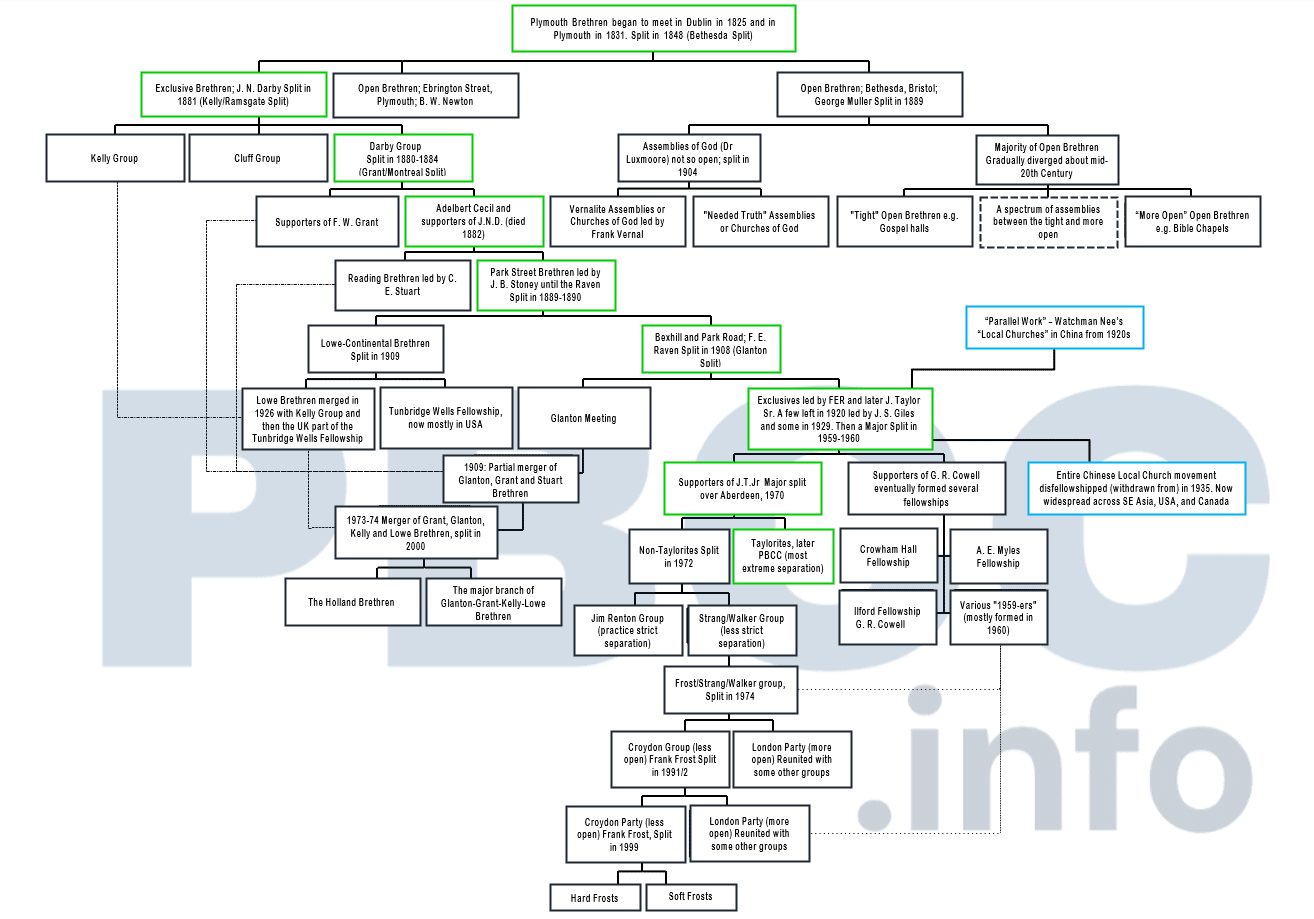
This chart traces the lineage of the current PBCC (Plymouth Brethren Christian Church) branch of the Exclusive Brethren from its inception in the 1800s through to today. Starting with John Darby in 1825, follow the green thread on the chart below through a multitude of splits, right through to the PBCC of today, led by Bruce Hales. Click on the chart to enlarge it:
Plymouth Brethren Origins Video
The video below gives a bit more historical background to the various Plymouth Brethren denominations including the PBCC:
The historical background of the Exclusive Brethren, now PBCC
The Plymouth Brethren Christian Church (PBCC) is a Christian group that traces its origins to the wider Plymouth Brethren tradition, a Protestant movement that began in the early 19th century in Britain and Ireland. The PBCC was formerly known as the Exclusive Brethren until they rebranded themselves as the Plymouth Brethren Christian Church in 2012.
The Brethren movement traces its origins back to Dublin in the 1820s, when a few men and women, including John Nelson Darby, Anthony Norris Groves, John Gifford Bellett, Edward Cronin, and Francis Hutchinson, broke away from the established church because they were concerned about it’s practices (in particular, the appointment of paid clergy who were not sincere Christ followers).
They were joined by Christians from a variety of different denominational backgrounds and met regularly for Bible study, prayer. Early Brethren groups emphasised simplicity in worship, the authority of the Bible, and gathered together without a formal clergy system, which set them apart from the traditional churches of the period such as the Church of England and the Roman Catholics.
The term “Plymouth Brethren” comes from the English city of Plymouth, where a particularly large Brethren congregations became well known during the 1830s and 1840s.
The Leaders
One of the most influential early figures associated with the movement was John Nelson Darby. His written works have been widely influential across protestant Christianity, particularly in the area of ‘dispensationalism’. Darby became the most prominent leading voice among the movement. He often took an uncompromising and dogmatic approach, and differences over church governance, fellowship, and doctrinal interpretation eventually led to a series of divisions and multiple branches, as shown on the chart above.
The PBCC group that forms the focus of this website is the group that followed these leaders:
- John Nelson Darby
- Frederic Edward Raven
- James Taylor (Senior)
- James Taylor (Junior)
- James Harvey Symington
- John Stephen Hales
- Bruce David Hales
In more recent decades, they have sometimes been called them the Raven-Taylor-Hales Brethren, or Taylorites, in order to distinguish them from other Exclusive Brethren groups that split off at various points.
Since 2012, the organisation has increasingly used the name “Plymouth Brethren Christian Church” in its public communications.
No major divisions since 1970
Following the doctrine of extreme separation introduced by James Taylor Junior (aka JTJnr or Mr Jim) in the late 50s and through the 60s and then the major split following the Aberdeen meetings in 1970, there has not been a major division in the Raven-Taylor-Hales Group of the Exclusive Brethren.
100% loyalty to the ‘elect vessel‘ or ‘man of god‘ (the group leader) became a ‘test of fellowship’ in 1970 in the wake of the Aberdeen meetings, suppressing any kind of dissent from that point forward, and allowing the easy expulsion of any opposing voices from the group.
The 100s of new rules known as ‘directives’ that were issued in the 60s created a large point of difference between those inside and those outside the group, creating a sense of togetherness and trust along with a fear and distrust of ‘the world’ without.
While a few individuals have continued to leave the group during recent decades (at great personal cost, often losing family, friends, and employment), there have been no mass divisions since 1970.
Those inside the group would say that this cohesion during the last 70 years is due to Mr Jim’s masterful ‘ambush’ that purged out those who were never truly part of the Brethren in the first place, and would also regard the lack of divisions as a sign of the rightness of their branch in comparison to other less controlled groups, some of whom who have continued to split and merge.

The author has used a variety of internal and external information sources and evidence-tested them to ensure that the contents of these blogs are as accurate as possible. If you spot any errors or omissions, please contact pbccinfo@proton.me



One Comment