
PBCC and Exclusive Brethren Jargon Explained
Like many close-knit communities, the PBCC (Plymouth Brethren Christian Church) has developed its own vocabulary, with everyday words and phrases often carrying meanings that differ from ordinary use. This unique in-language can confuse outsiders while reinforcing a shared identity within the group.
This glossary explains common PBCC and Exclusive Brethren terms to help readers better understand the group’s language, culture, and conversations.
Same Words, Different Meaning
Examples of when the same words have different meaning to those “in”, to those “out”:
- Aberdeen – At Aberdeen, Scotland, there was a hotly contested scandal in 1970 involving the group leader at the time, James Taylor Junior (JTJnr), that caused the last known major division. This incident is often referred to within church discussions even today, and the whole occasion and subsequent repercussions are usually referred to as simply ‘Aberdeen’, for example “have we got the gain of Aberdeen yet”.
- Assembly Discipline – see withdrawn from.
- Assembly Widow – a female PBCC member (sister) whose husband has been withdrawn from. Once withdrawn from, he is regarded as spiritually dead, and all remembrance of him is usually removed, including photos, leaving the wife effectively widowed even though the husband is still alive. Sometimes the term used is widow for the truth.
- Asking round – before Bible reading takers became pre-arranged in recent years, someone would be appointed to ask various brothers at the start of a Bible reading meeting whether they had any scriptures for the brethren. They might ask quite a few different ones before someone agreed to read some scriptures and head up the discussion. The brother with this job used to be the most senior elder who takes the lead in that locality, however, in recent years, since these meetings became prearranged, this is now no longer a prominent role, and the once common question “who asks round in [name of locality]” is now rarely asked as it is no longer an indicator of who is the main leader in that place.
- Brethren – when speaking to each other, members of the PBCC typically just refer to themselves as “the Brethren”. It is normally only when speaking to the outside world they sometimes use their full title Plymouth Brethren Christian Church, to help distinguish them from the dozens of other Christian groups who also call themselves Brethren or Plymouth Brethren.
- Brethren way of life, the – this is a significant and broad term including not both living an unworldly life separate from evil, but also certain minimum standards of living, for example, the size of house, ability to afford private healthcare, and quality of food and drink used to entertain the brethren at regular intervals. Within the brethren they may say “are you earning enough money to be able to live the brethren way of life”. On their website they say people can only join them if they are “prepared to commit to our beliefs and way of life“, showing the significance of ‘the brethren way of life’ within the community. There are many directives that have been given over the years that govern the brethren way of life, however, these can change. For example, from the 60s onwards, many rules appeared such as no holidays, travel should be strictly for visiting relatives or business or fellowship meetings, no pets, no visiting beaches in summer, no visiting restaurants, no pre-recorded music. But during the last 20 years, rules about visiting beaches in summer, restaurants, etc, seem to have been relaxed, and pre-recorded music is now allowed although it has to be brethren-produced music; the no-holidays rule remains, dogs and cats are still not allowed but smaller pets such as fish or rabbits are allowed for children.
- Blue books, the – any printed ministry of James Taylor, so-called because of the colour of the book covers.
- Books – your bible and hymn book that you take to the church sessions are simply called your books, e.g. “you’ve left your books in the car”.
- Brothers – the menfolk are all called brothers, not men, because they are regarded as ‘brethren in Christ’. See also Sisters.
- Brown books, the – normally the printed ministry of John S Hales, which have dark brown covers, however, the earlier ministry books of James H Symington have light brown covers, so occasionally this term could be used to refer to any ministry books later than James Taylor Junior’s ‘Green Books’ and Mr Raven’s ‘Red Books’ (see below).
- Burgundy books, the – any printed ministry of Bruce D Hales, so-called because of the colour of the book covers, which are a reddish brown.
- Church – the PBCC church buildings are called meeting rooms, so this word is normally used to refer to the buildings used by other denominations.
- City room – the main meeting room for any particular locality, as distinct from the subdivisional rooms.
- Collective Position, the – this is a way of referring to the PBCC position within certain contexts. See the Testimony and the Recovery for further details.
- Community, the – this is the modern way to refer to the brethren, especially when speaking to external government agencies or non community people.
- Confined – this is where someone is not allowed to attend PBCC meetings. See also shut-up, or see this PBCC produced Podcast from 1:43 onwards.
- Connect App – this is the digital version of the photo albums, and contains extra features such as the ages of all members, details of Lordsday dinner allocations, Orbit information, times of meetings, etc.
- Ecosystem – a relatively new words within the PBCC community (coined within the last decade or so), this describes the many and various connected charitable and commercial entities that are run purely by members of the community that work together to support the brethren way of life and the financial needs of the PBCC. The ecosystem includes (this is just a few examples):
- OneSchool Global (OSG)
- Universal Business Team (UBT)
- Rapid Relief Team (RRT)
- Campus&Co
- PBCC Services
- PBCC Properties
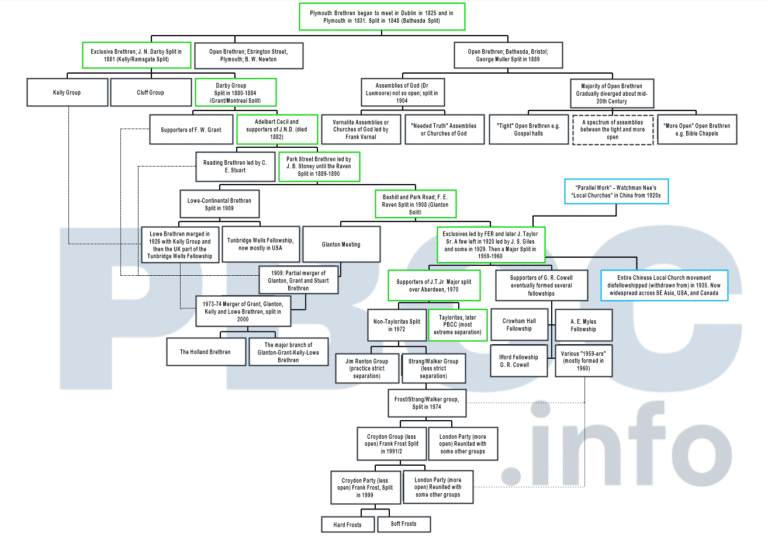
- Exclusive Brethren – this is one of the most common names given to the group that now call themselves the Plymouth Brethren Christian Church. Due to the many splits of the original Plymouth Brethren movement, there are actually several branches of Plymouth Brethren known as ‘Exclusive Brethren’ to help distinguish them from the splinter groups known as ‘Open Brethren’. This is a complex topic outside the scope of this blog that is covered well already on Wikipedia, or see our this chart on our Exclusive Brethren history blog post. Often abbreviated to EB or EBs.
- Fellowship, the – if PBCC members talk about ‘the fellowship’ they mean the PBCC.
- Fellowship, in – ‘in fellowship’ simply means you are an accepted member of the PBCC.
- Fellowship Meeting – any meeting where church members from a wide area are given special invitations to attend, normally followed by times of fellowship in the houses of the host locality and sometimes combined with organised sightseeing group tours around the local area to treat the visitors. They sometimes 1-day events, especially if the minister is the current global leader, but they are sometimes longer events, either:
- Weekend Fellowship Meeting – this normally starts on a Friday afternoon, and ends on the Sunday, but visitors travelling from long distances e.g. via plane from different countries may sometimes arrive at their host’s house as early as Wednesday or Thursday, and leave as late as Monday or Tuesday, depending on travel arrangements.
- 3-Day Meeting – these used to be common but are largely now replaced with Weekend Fellowship Meetings – the only difference is the visitors all arrive at their host’s houses on the Thursday, there is no church service on the Thursday, and then the church services and meals in houses start in earnest from Friday morning through to Sunday afternoon.
- Oversees trip – this is a highly organised oversees trip normally around 1-2 weeks in length, containing a mixture of fellowship meetings at the weekends, routine meetings at their host locality mid-week, and lots of organised outings to see the local tourist attractions, and lots of entertaining in the houses.
- First Family – this refers to your natural family, i.e. the household unit, in contrast to the second family which is a spiritual idea incorporating all members of the PBCC.
- Going to the table – officiating at the breaking of bread, i.e. giving thanks for the emblems and passing them to the congregation.
- Golden advice – advice from Bruce D Hales or any past leader.
- Gone astray – describes someone who has left the PBCC/Exclusive Brethren
- Great Men Canvases – virtually every community member’s living room would contain a canvas showing the 7 leaders of the recovery, purchased from UBT products.
- Green books, the – any printed ministry of James Taylor Junior, so-called because of the colour of the book covers.
- Halls – this is the name they give their meeting rooms when speaking to outsiders, but it is rarely used when talking to other members.
- Housing plan – most localities have a housing plan that identifies where brethren should and shouldn’t live. Brethren have some quite specific rules about what houses they can live in – they must be detached, and it is recommended that they have at least 4 bedrooms and 2 bathrooms, are not on a cul-de-sac, they should not have shared drains or shared drives, and they should be within a few miles of a subdivisional room. The house should also be in a good area, they use often government depravation index and crime data to help decide which areas are suitable to live in. All of these criteria are used to form a housing plan which is circulated among church members so that they know where they should live and not live.
- Interchange – all except the most isolated of localities would routinely meeting with members of 1, 2, or 3 nearby localities as part of a repeating weekly cycle. This is mostly only at weekends nowadays, although it used to be mid-week too. A few localities that have longer distances to travel to their nearest neighbouring meeting will join up less often, and sometimes only 1 or 2 households will travel each time if the distances are large or involve travel by plane or boat. But normally if the nearest locality is less than 2 hours away, there will be a weekly cycle where all members visit the other locality at least once a week.
- Issue of the truth – usually some doctrine that is regarded as not optional and there would be serious negative consequences if it is not followed. For example, while side partings for men are encouraged, that is not an ‘issue of the truth’, whereas eating or drinking with a non-member would be regarded as a serious breach of their separation doctrine. See also test of fellowship.
- Levites – anyone who is involved extensively in activities within the group are known as levites. The primary use of this word is for those who take a lot of meetings, especially fellowship meetings, however, sometimes those who are heavily involved in ecosystem entities such as OneSchool, UBT, or RRT, might also be loosely regarded as levites, as might those extensively involved with care for brethren in need or those involved in priestly visits. Informally, among the less senior members, levites are sometimes called heavies.
- Locality – the brethren tend to live in tight geographical areas close to their church meeting halls. They have a main church hall for an entire locality called the city room, this normally has a large seating capacity, normally at least 500, but often seating for 1000 or more members, so that they can act as a host locality for fellowship meetings and interchange meetings. A locality is normally then sub-divided into several subdivisions unless it is very small, these subdivisions and the main locality meeting hall are normally all within a close proximity, e.g. 20-30 minutes drive maximum to get from one side of the locality’s housing area to the other, although the distance does vary as it depends somewhat on the availability and location of large detached houses suited to the brethren way of life. This map shows all the PBCC localities in the UK.
- Lordsday – this is virtually always the term they use instead of Sunday when speaking to other members. They normally switch to Sunday when talking to non-PBCC members.
- Meeting Room – the name they give to their church halls when speaking to each other.
- Meeting, the – all of their church services are called meetings, e.g. “we’re going to the meeting”.
- Ministry, the – the printed writings of earlier leaders, and the printed transcripts of meetings taken by leaders from Mr Raven onwards (Mr Darby’s meetings were rarely recorded so it is mostly just his transcripts that are included in ‘the ministry’), and also the letters of the leaders are included within the ministry.
- Non-coms or Non-Community – this is the new politically correct alternative to wordly people, i.e. people who are not part of the brethren community. In the business world, this is regarded as potentially discriminatory under HR legislation, so employees who are not part of the brethren community are generally called wider community in the workplace.
- Opposers – anyone who publicly speaks out against the PBCC are known as ‘opposers’. This is a very serious label, because these people are generally regarded as apostate and not saved.
- Orbit – a highly organised system to manage oversees travel arrangements, community events such as fellowship meetings and business seminars. Orbit manages everything from booking flights, trains, and coaches, to providing community ushers in high-vis jackets to meet, greet, direct, and serve refreshments to community travellers and community event attendees. Orbit members and volunteers are highly trained and instructed how to dress, speak, smile, and deport themselves, leading to widespread respect and admiration from both inside and outside the community.
- Outs, the – while this can be used to refer to anyone who has left the PBCC, is therefore ‘out of fellowship’ – it most often refers to either those who left after the Aberdeen incident in 1970, or else those who are actively opposed to ‘the position’. Example: “when so-and-so was withdrawn from wrongly, he was careful to not join up with the outs”. One ex-member recounts: “early sixties – there were “in-outs” and “out-outs”. The former wished to recreate traditional exclusives culture minus Jim Taylor’s more recent rules and witchhunts. The latter were open to finding other “faithful biblical christians” and working with them…it was the time of the Billy Graham Crusades in UK and there were ample opportunities. Most out-out meetings quickly (within a year or two) dissolved as members found a new home. Some in-out groups joined with the Aberdeen leavers and still survive”. Another member says: “My exit was 1982 and the terminology at that time was…outs were any who were recently withdrawn from…it applied to those who went out at Aberdeen. The many that had split away many years before generationally distant and unknown to those of us currently living were hardly referred to at all, mostly known as Open Brethren. It seemed almost like they were just another mainstream church.”
- Peebs – a slang term coming from the abbreviation of Plymouth Brethren (PB). This term used to be widely used but is now regarded as negative within the community, so tends to be used only by those who have gone out recently.
- Position, the – this, along with ‘the testimony’ is used to within the PBCC to refer to themselves, often in the context of being under attack, e.g. ‘the devil has been attacking the position since it started’.
- Priest – an elder that is involved in visiting people.
- Priestly – sometimes used as a noun to refer to a Priestly Visit, see below. At other times it is used as an adjective, to describe a member of the PBCC who is able to keep secrets and doesn’t spread incriminating information. It is based on the scripture in Malachi 2:7 that says “priest’s lips keep knowledge”.
- Priestly Visit – this is where church elders visit someone who has become a concern to the congregation because of some sin or because of not following the PBCC way of life. There are usually 2 ‘priests’ on an priestly visit, it is not thought OK for just 1 priest to visit.
- Recovery, the – short for ‘the recovery of the truth’, it usually simply refers to the history of the Brethren movement from John Nelson Darby through to the current leader of the PBCC. Sometimes it is used interchangeably with ‘the testimony‘, but carries a slightly different context of being particularly related to ‘the truth of the collective position as recovered by these great men‘ such as separation.
- Rival – someone who is not only against the current leader (who would be called an opposer), but also tries to draw away a following after them. The supper occasions of the breakaway meeting may be called a rival table.
- Second family – all PBCC members are part of the second family – brothers and sisters in Christ. See also First Family.
- Separation – this is a core doctrine that is very important to the group. It is based mainly on 2 Timothy 2:19-21 which in the Darby Bible says: “19 Yet the firm foundation of God stands, having this seal, [The] Lord knows those that are his; and, Let every one who names the name of [the] Lord withdraw from iniquity. 20 But in a great house there are not only gold and silver vessels, but also wooden and earthen; and some to honour, and some to dishonour. 21 If therefore one shall have purified himself from these, [in separating himself from them], he shall be a vessel to honour, sanctified, serviceable to the Master, prepared for every good work.” The words [in separating himself from them] in square brackets were inserted by the PBCC founder John Nelson Darby, in order to give context to the passage (much in the same way that the amplified version has phrases added to provide explanations). In the most recent edition of the Darby Bible, the square brackets are removed, so the verse reads as though the original manuscripts included that addition. Other scriptures often referred to in connection with the PBCC doctrine of separation are 2 Corinthians 6:17 (“come out from the midst of them, and be separated”) and Hebrews 13:13 (“go forth to him without the camp”). The PBCC doctrine of separation includes some ideas which do not seem to have any scriptural basis, such as only eating and drinking with those with whom they celebrate the Lord’s Supper, meaning that if family members are withdrawn from, they can no longer share meals with the rest of their family, and typically end up living separately as well, although when communicating to the Charity Commission from 2009 to 2014, the Brethren quoted from a statement of Faith In Practice which claimed ‘The principle of separation is set out which confirms that it “involves drawing away from the world in a moral sense, rather than in a physical sense” and “permits inter-personal communication and social interaction with non-Brethren (including former Brethren)…’ – as shown in this Charity commission document.
- Shut up – see Confined, the two words are used interchangeably.
- Silver books, the – these are business seminar books published by UBT.
- Sisters – all the female members of the PBCC are called sisters, not women, because the are part of the second family or brethren in Christ.
- Subdivision – virtually every locality is split into 2 or more sub-divisions, each with around 30-50 members. The only exception is if the locality is very small, e.g. 60 members or less, they may then have just 1 subdivision. The size of the subdivisions are determined by how many people it is practical to hold their Lord’s Supper occasions with – they only use 1 cup and 1 loaf and they like the occasion to be no longer than 1 hour, so these limiting factors make it necessary to split into smaller gatherings when there are more than 50 members.
- Subdivisional rooms – They have small meeting rooms set aside for their supper meetings, although 1 of the Supper Meetings will be held in the main locality hall. So a locality of 3 subdivisions, for example, will have 2 subdivisional rooms, and the 3rd supper meeting will be held in the main meeting room. These small meeting rooms are sometimes purpose built, but often they are converted houses or converted church buildings that have been made to suit their purposes of a large internal room and a car-park with capacity for at least 10 cars. Occasionally they will hold supper meetings in their houses, but this is regarded as a temporary arrangement when numbers in a specific area have increased prior to them being able to build a new subdivision room, or is done at their fellowship meetings when they have a temporary influx of visitors meaning they cannot all fit into the dedicated meeting rooms for that weekend. They also use the subdivision rooms for their Monday night prayer meetings (again to help keep the meeting short because nearly all the brothers pray at these meetings), and they will also often use them for the last set of preachings on a Lordsday afternoon, following the earlier interchange meeting in the main meeting room in the morning.
- Sydney – while they use this word to refer to the city of Sydney in Australia like everyone else, they also frequently use it as a way of referring to any direct that has come ‘from the top’, i.e. from some of the Sydney-based Elders, one of the Hales family members, or from Bruce D Hales himself. This is particularly common when trying to protect the leadership team who normally want to be anonymous when delegating commands down to local level administration, who will say e.g. “we have just heard back from Sydney about this matter”. Any directive that is labelled as ‘from Sydney’ carries immense weight, and is normally obeyed immediately and without question.
- Take – if someone leads a Bible reading, they ‘take’ the meeting, e.g. someone might ask “who took the meeting tonight”.
- Taken – if someone is taken, it means they have died, i.e. taken to be with the Lord Jesus, e.g. “the Lord has taken our brother”
- Taking The Lead – in the 80s and 90s there would normally be 1 prominent person in every locality who “took the lead” and asked round and who would normally be involved in or at least aware of all priestly visits, and who would always attend the universal meetings each year.
- Test Of Fellowship – any activity or belief that is likely to lead to you being withdrawn from may be described as a test of fellowship. Examples could include openly opposing the group leader, expressing doubt that James Taylor Junior was a pure man in the Aberdeen incident, or persistently breaking the rule about not eating or drinking with those they don’t break bread with.
- Testimony, the – this refers to the PBCC movement, especially in a public or historic connection, when talking about how they relate to the wider world around them, for example “to protect the testimony” means “to protect the PBCC as a group”, but it also has a slightly wider meaning as it can also include their teachings, but normally the recovery is the term used when doctrine is concerned.
- UBT – stands for Universal Business Team, and is a wide reaching organisation offering a wide range of products and services to community members, including the following:
- Business Advisory – nearly every brethren-run business has UBT Advisors, small ones tend to have 2 mentors, larger businesses may also have board assist which is a larger panel of advisors or board members that provide strategic direction to the business owners.
- UBT Products – a huge range of products of interest to community members, ranging from printed photo albums containing photos, names, and addresses of all members, the Connect App, Great Men Canvases, books such as The Frontline Series, Streamline3 Computers and Phones, Trove App, and much more.
- Universal Meetings – also known as ‘the Universal Occasion’, these meetings are held approx annually, although the frequency has been more varied recently. ‘Those involved in the work and labouring’, widely known as levites, would be selected via an unknown means to attend these meetings, with ‘representatives from every locality universally’ attending these annual conferences.
- White Books – these are disposable small booklets printed in advance of thicker and more durable monthly ministry volumes are published. They have plain white paper covers, hence the name. They are designed to ensure that all members of the PBCC can have a written copy of the latest words of the man of God within just a few weeks (or sometimes days) of him speaking. Any meetings that are taken by the current leader are normally published in a white book within a few weeks. Adult members of the group would be expected to read all the white books soon after they are published, normally 5 to 10 pages per day is sufficient in order to do this. They call this “keeping up with the white books“. Younger members are are provided with white books at no additional cost from primary school age (the parents are expected to buy an annual ‘household subscription’, and then any children they may have get them within that subscription, and the price is the same for a family with 0 children as a family with 10 children). While pre-teen members would be expected to read them, they don’t have to read all of them, and their parents can optionally select a pocket whitebook option for their children, which is smaller and has less content.
- Withdrawn from – this is similar to shunning or excommunication or disfellowshipping. It usually follows a period of being shut up or confined, and is for those who do not change their ways after a period of being confined. Once withdrawn from, those within the PBCC normally avoid all contact with the one who is under discipline.
- Worldly – often used to describe activities or people who are not in line with the rules that the PBCC follow.
- Worldly People/Worldlies – people who are not brethren. This term used to be commonplace but in recent decades has been discouraged, and replaced with less offensive terms like “non-community” (often shortened to non-coms), or even wider-community.
PBCC Names for The Eucharist, Holy Communion, and The Lord’s Supper
While many Christian denominations have their own word for the occasion where they remember the command of the Lord Jesus “this do in remembrance of me” (1 Corinthians 11:24 and Luke 22:19 in the KJV) by partaking of wine and eating bread, the PBCC have multiple names that they use:
- The Supper Meeting – probably the most commonly used term among adult members
- The Bread and Wine Meeting – probably the most common term used by young (pre-teen) members, and often used by adults when speaking to children members
- The Breaking of Bread – another common term used term among adult members
- The Lord’s Supper – used instead of Breaking of Bread by some adults
- The Essential Occasion – often used by the leader, but rarely by the congregation
- Our Time This Morning – commonly used during the Sunday morning bible reading to describe the separate 6am Supper Meeting occasion earlier in the day.
Titles of the Leaders
The leaders of the PBCC have so many titles that it is easier to list these out separately, see below:
Generic Titles
These apply to all leaders:
- the Elect Vessel
- the Paul of Our Day
- Paul – (within their meetings they will often use Paul’s name to mean Mr Hales, e.g. “the way Paul is leading us currently”)
- the Great Men
- the Man of God
- the Lord’s Servant
- Those who have gone before (any past leader no longer alive)
Specific Titles
These only apply to specific leaders:
- The Beloved – James Taylor (JT)
- Our Beloved, or Mr Jim – James Taylor Junior (JTJnr)
- Our Beloved Brother – usually John S Hales but sometimes Bruce D Hales
- Our Beloved Brother Currently – Bruce D Hales – this is the usual title used during church gatherings
- Our CEO – Bruce D Hales – this title is most often used when talking about OneSchool or UBT
One former member recounts: “historically we did not formally recognise leaders as theoretically we were all equal in God’s sight. However we regularly referred to JND, FER, JBS and JT as revealing truth to us and they would often be quoted. The labelling started with JT Junior around 1970.”
Another form member states: “Brethren stopped referring to leaders by their initials which had at one time been quite common; “according to JND”, “JT said”. It was thought to be too impersonal. Instead, “Mr. Darby”, “Mr. Raven”, etc. There were also affectionate nicknames applied to some, for instance JTJr as Big Jim, and Jim Symington was the Chief. In the sixties I was taught that JND, FER and JT were the 3 great ministries in the history of the recovery.”
Test Your Knowledge
This fun and educational quiz video will test your knowledge of the Plymouth Brethren, including both the PBCC group and all the other groups that have split off from the original movement founded by John Nelson Darby in the 1800s:
Acknowledgements
Many thanks to the many ex-members who helped to contribute to the above. As many of the contributors still have family and friends within the group, we will not name them here, but would still like to express thanks to you all.

The author has used a variety of internal and external information sources and evidence-tested them to ensure that the contents of these blogs are as accurate as possible. If you spot any errors or omissions, please contact pbccinfo@proton.me